Beverages for employees: What is allowed, tax-free and practical?
Free Beverages for employees are tax-free – if two conditions are met. The drinks are consumed on the premises, and they are provided in addition to the regular salary. No salary sacrifice, no paperwork, fully deductible as an operating expense. From a room temperature of 30 °C, the provision of drinks actually becomes a legal requirement. What you can specifically offer, how to book it correctly and which solution really works in everyday practice – you can find summarized here.

4 min read

Tax and Law: What Employers Need to Know About Free Beverages
Free Beverages for employees are tax-free under two clear conditions – and are fully deductible as a business expense. The tax logic behind this is simpler than it sounds. For detailed individual questions, we recommend consulting a tax advisor.
Conditions: When are free Beverages for employees actually tax-free?
Free Beverages for employees are only tax-free if two conditions are met: The Beverages are consumed on the business premises, and they are provided in addition to the salary already owed – without salary sacrifice.
Condition 1: Consumption on the business premises
The Beverages must be consumed at the workplace – office rooms, kitchen, break room. As soon as they are taken home, the tax category changes: Then the non-cash benefit logic applies with an exemption limit of EUR 50 per month and person (as of 2026). In practice, this is not a problem – if you have a water dispenser or a beverage solution in the office kitchen, you are automatically on the safe side.
Condition 2: In addition to the salary – no salary sacrifice
The Beverages must not be offset against salary components. If the gross salary is reduced in order to finance the provision, the tax exemption is lost. The perk must come on top – not instead of something else. Recommendation: Communicate clearly internally that Beverages are an additional benefit, not a salary component.
Legal basis: R 19.6 LStR. For detailed tax questions: consult a tax advisor.
Perk, hospitality or non-cash benefit – the difference in a table
The tax classification depends on the context – not on the beverage. Whether water in the office kitchen or wine during a client meeting: The tax office distinguishes three categories, with very different consequences.
Category | Definition | Tax treatment | Example |
Perk (Aufmerksamkeit) | Beverages for consumption on the business premises | Unlimited tax-free; 100% business expense | Water, coffee, tea, juices in the office kitchen |
Hospitality (Bewirtung) | Consumption as part of a business occasion | 70% deductible (§ 4 Abs. 5 EStG) | Business lunch with clients, hospitality receipt required |
Non-cash benefit (Sachbezug) | Non-cash benefit in addition to the salary | Subject to tax and social security contributions – except within EUR 50/month (SvEV) | Meal voucher, employee catering above non-cash benefit value |
Note: For Beverages for consumption on the premises, the EUR 50 non-cash benefit limit does not apply – these perks are tax-free without a value limit.
Special Case: Alcoholic Beverages for employees and clients
Alcoholic Beverages for employees are generally not a tax-free perk – they are only permitted for special personal occasions within the EUR 60 perk exemption limit per event (R 19.6 LStR).
Regularly provided alcohol at the workplace is tricky under occupational health and safety law and does not fall under the tax perk regulation. Individual occasions are to be assessed differently: A glass of sparkling wine for a birthday or signing a contract remains tax-free within the EUR 60 exemption limit – provided it is a personal event and no cash equivalent is given. For company parties, a separate exemption of EUR 110 per event and person applies, for up to two parties per year (§ 19 Abs. 1 Satz 1 Nr. 1a EStG). For client entertainment: 70% deductible with a proper hospitality receipt (§ 4 Abs. 5 EStG).
A well-thought-out alcohol-free offering – spritzers, flavoured water, high-quality juices – is the better choice anyway: no regulatory effort, no occupational health and safety problem, full tax exemption.
Legal basis: R 19.6 LStR, § 19 Abs. 1 Satz 1 Nr. 1a EStG, § 4 Abs. 5 EStG.
Am I obliged to offer free beverages?
There is no general legal entitlement to free beverages at the workplace – however, from a room temperature of 26 °C, measures are required, and above 30 °C, the provision of suitable beverages such as water is mandatory.
The basis: § 4 ArbSchG obliges employers to minimise health hazards. ASR A3.5 makes this concrete:
From 26 °C: Protective measures required, provision of beverages strongly recommended
Above 30 °C: Obligation to provide suitable beverages – at least water
Above 35 °C: Rooms are generally no longer suitable as workspaces
At high-heat workplaces – activities with a significantly increased body temperature due to physical exertion, heat or protective clothing – free non-alcoholic beverages are mandatory according to the Workplace Ordinance. For air-conditioned offices, the obligation is less frequently relevant – but given increasingly hot summers, it is not a topic to ignore.
What Beverages are you allowed to offer as an employer?
Water, coffee, tea, juices – all permitted, all tax-free. The range is wider than many think, and the choice determines whether beverages in the office are genuinely used or just sit there.
Water, coffee, tea, juices – and what else makes sense
Still water, mineral water, coffee, tea, juices, spritzers – all tax-deductible, all recognised as a perk. The condition remains the same: consumption on the premises, in addition to the salary.
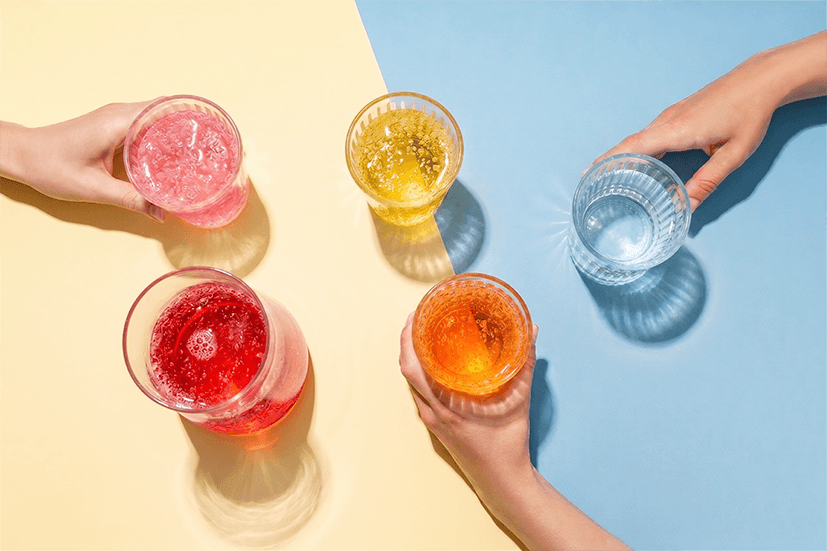
What determines the selection in practice: Those who only provide still water satisfy the basic supply. Nothing more. Flavoured water with natural essences and spritzers turn a must-have benefit into a real hydration trigger – without sugar, without artificial flavours, without compromise. What this can actually look like is shown by the current Re:Drink flavour selection.
What employees want most frequently
According to a survey by Indeed, 95% of employees want free beverages at the workplace. In reality, only 52 per cent get them. The most widespread is free coffee at 47.2%, mineral water at 37.3% and tea at 33.4%. Soft drinks and juices are offered by just under 10% of companies, even though 37.7% of employees want juices and around 25% want soft drinks at the workplace.
Expectation and reality therefore drift apart. What people want and what they actually drink are two different things – especially under stress. The TK hydration study 2019 shows: Around half of working professionals do not reach the recommended daily amount. Why this is so – and what helps – you can find out in our Hydration Guide.
For HR and office management, the beverage selection is a direct lever for employee retention and appreciation. Small effort, big impact.
What do free beverages for employees actually cost?
Less than you think – or more, depending on how you calculate. The difference lies in what is not on any invoice.
Model | Typical cost drivers | Effort |
Buy & carry yourself | Shopping time, transport, storage, waste disposal | Feasible for mini-teams under 10 people – uneconomical above that |
Bottle delivery service | Deposit, delivery logistics, staff time, waste volume | Planable, but hidden time effort remains high |
Mains-fed water dispenser with service | Monthly flat service fee, no logistics, no ordering | Planable total costs, no carrying |
The cheapest entry-level option is rarely the most cost-effective solution.
Hidden costs: Staff time, logistics, deposit
Ordering, receiving, stocking up, deposit management, storage space, waste – all of this ends up in the HR budget without ever appearing as beverage costs. Modern mains-fed water dispenser solutions are around 70% lower in total cost comparison than classic bottle supply – because precisely these items are eliminated.

From 20 people onwards, bottle supply structurally becomes a time-waster. The costs are not on any beverage invoice – but very much so in the HR budget.
How do you organise beverages for your team practically?
Four options, very different realities. What seems cheap at first glance rarely pays off – those who factor in the overall effort quickly reach a different conclusion.
Model | Suitable for | Weak point |
Buy yourself | Teams under 10 people | Not scalable; time effort increases linearly |
Bottle delivery service | Teams with flexible requirements | Deposit, logistical effort, delivery failures possible |
Water dispenser with carboys | Basic supply without mains-fed connection | Manual change, hygiene risk, no flavour options |
Mains-fed water dispenser with service | Teams from approx. 30 daily users | One-off installation required; fully automated thereafter |
Drink more, work better: What the numbers show
Those who take workplace hydration seriously get back more than happy employees. Re:Drink's own survey in 8 companies (January 2026) shows what happens when daily hydration really works:
58% of employees demonstrably drink more per day with Re:Drink
44% report a noticeable increase in their personal productivity
56% experience an improvement in office atmosphere and team spirit
Why this is so – and what science and practice have to say about it – can be found in our Hydration Guide: Focus, productivity, and drinking habits at the workplace.
Re:Drink: An All-in-One Solution for Water (with Flavour) and Spritzers at the Workplace
In case you don't know us yet: Re:Drink is a B2B complete solution for beverages at the workplace. Directly linked to the mains water supply – without bottles, without ordering, without carrying. Filtered tap water meets regional, largely certified organic essences. The result: flavoured water and spritzers in five intensity levels – from still to sparkling.
Four arguments that count in practice:
1. No effort, no logistics. Ordering, replenishment, and maintenance run automatically – including a bi-weekly technician service. The time previously spent on bottle management belongs to the team once again.
2. Up to 70% cheaper than classic bottle supply. In a direct total cost comparison – including all hidden costs – Re:Drink is significantly below what bottle delivery services cost on an annual basis.
3. 90% fewer CO₂ emissions compared to bottle supply.
TÜV- and ISO-certified hardware from a traditional Austrian business, supported by a DACH-wide network of technicians. Suitable for workplaces with 30 or more daily users.
Conclusion: More Than Just an Employee Benefit
Free beverages for employees are legally simple, tax-privileged and organizationally much easier to implement today than just a few years ago.
However, what the numbers behind it show goes beyond tax optimization. Beverages that offer variety and taste increase average consumption, productivity, and well-being in daily office life.
Beverages for employees are one of the few benefits that are simultaneously tax-efficient, health-promoting, and culture-shaping. And with the right solution, it almost organizes itself.
See for yourself – with a non-binding test month.