Sugar-free? Reduced sugar? What’s really behind it? A guide for your office.
More and more people want to cut down on sugar – in everyday life, at the office and during sport. But terms like sugar-free, reduced sugar or no added sugar often confuse more than they help. At the same time, new sugar substitutes and sweeteners are constantly coming onto the market, all supposedly better than the rest. But what’s really behind them? And which choice makes sense for your workforce in the long term?

4 min read

1. What actually is sugar?
“Sugar” is an umbrella term for various sweet carbohydrates. Classic table sugar (sucrose) provides energy and gives the typical sweet taste. However, it is also suspected of contributing to overweight, type 2 diabetes and dental problems when consumed excessively – risks you want to minimise in a healthy work environment.
2. What are sugar substitutes and sweeteners – what is the difference?
Sugar substitutes are sweeteners that mimic the taste of sugar – but contain fewer or no calories.
Category | Examples | Characteristics |
Real sugar | Sucrose, glucose, fructose | Provides energy (calories), affects blood sugar & insulin. |
Sugar alcohols | Xylitol, erythritol, sorbitol | Contain fewer calories than sugar, but still have an energy value. |
Non-nutritive sweeteners (NNS) | Aspartame, saccharin, sucralose, acesulfame K | Almost calorie-free, very sweet relative to sugar. |
Naturally derived sweeteners | Stevia, monk fruit (Monk Fruit) | Low in calories or calorie-free. |
3. Sugar substitutes vs. real sugar – pros and cons
As the person responsible for employee health, you need to weigh up the arguments:
Advantages of substitutes:
Reduced calorie intake: substitutes provide little or significantly fewer calories and can therefore help with weight management in the short term. [2]
No sharp blood sugar spike: relevant for employees at risk of diabetes.
Tooth- and cavity-friendliness: a plus point for health promotion in the company.
Critical aspects & drawbacks you should note:
Long-term benefit disputed: the WHO explicitly advises against recommending non-sugar sweeteners for long-term weight control. A clear long-term advantage has not been proven. [1], [2]
Possible metabolic risks: studies have found associations between high sweetener consumption and an increased risk of cardiovascular disease. [3] There is also new evidence for some sugar alcohols indicating increased risks of heart problems. [4]
Gut flora & appetite: NNS can influence the gut microbiome. In addition, the sweet taste without calories can irritate the appetite system, which can lead to the so-called “justification effect”. [5], [6]
Psychological effect (compensation): if you consume light or zero products, you may feel that you have “saved calories” and then eat or drink more elsewhere. This compensation can cancel out the health benefit. [6]
4. Does sugar substitution lead to cognitive decline? Productivity at work in focus.
Especially in an office environment, cognitive performance is crucial. High sugar consumption is associated with poorer memory and thinking functions.
However, caution is also needed with sweeteners: a recent large-scale study associated high consumption of low-/no-calorie sweeteners with faster cognitive decline. [7]
Safety: most sweeteners are considered safe in the EU in the permitted amounts. Nevertheless: the research speaks of associations, not causality. [7]
5. Navigating the terminology jungle
As a purchaser or person responsible, you need to know what the labels mean.
Term | Meaning |
Sugar-free | Contains max. 0.5 g sugar per 100 ml or 100 g. |
Reduced sugar | At least 30% less sugar than a comparable product. |
No added sugar | No sugar has been added, but natural sugars (e.g. from fruit juice) may be included. |
These distinctions are essential in order to correctly classify advertising for Beverages without sugar.
6. What does this mean for your mindful consumption in the office?
Your best strategy is transparency and control. Whether sugar or substitute – the total amount and frequency count.
Your recommendations for the office:
Establish a baseline: offer water and unsweetened Beverages as the clear standard option.
Choose sweetness consciously: help your team reduce their habituation to sweet taste.
Manage amount and frequency: communicate transparently: sugar-free is not a free pass.
Conclusion: only with transparency, mindful handling and genuine freedom of choice can sugar consumption be reduced without risk, without sacrificing enjoyment.
This is how you create a healthy beverage mix in the office:
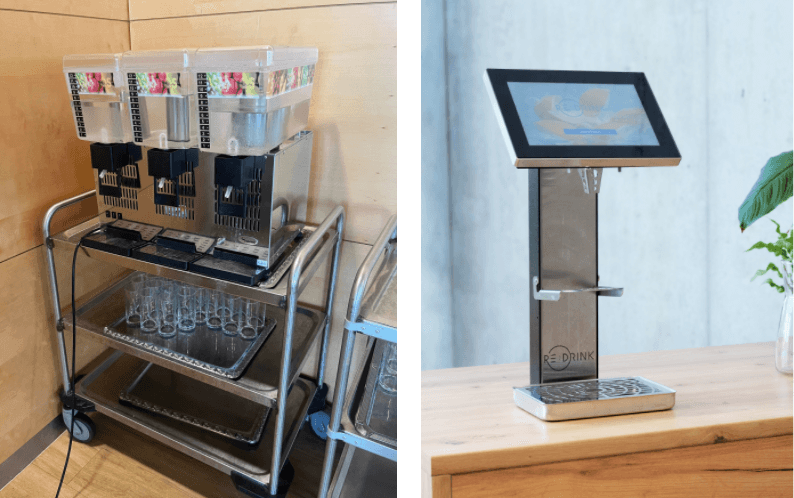
At Re:Drink, we rely on natural fruit sugar and eliminate sweeteners and flavour enhancers. We create the option for everyone to decide for themselves how much goes into the drink.
With Re:Drink, you keep an eye on your sugar consumption and decide for yourself how sweet your beverage should be – from mild to intense in 5 levels. Try it out and customise your beverage at the touch of a button entirely to your taste!
References
[1] World Health Organization (WHO): Recommendation against the long-term use of non-sugar sweeteners (as of May 2023). https://www.bundesgesundheitsministerium.de/themen/internationale-gesundheitspolitik/global/who.html
[2] Mayo Clinic; World Health Organization (WHO): studies on short-term benefits versus unclear long-term benefits. https://www.mayo.edu/research/clinical-trials
[3] BMJ: review article on associations with cardiovascular diseases. https://www.bmz.de/de/mitmachen/studierende-16516
[4] European Heart Journal / Nature Medicine: studies on increased risk from xylitol and erythritol. https://reposit.haw-hamburg.de/bitstream/20.500.12738/7245/1/Kristina_Roos_BA.pdf
[5] PMC/BfR: evidence of effects on the gut microbiome. https://www.hirslanden.ch/de/hirslanden-klinik-aarau/centers/institut-fuer-gastroenterologie/darmflora-interview-mit-stephan-teyssen.html
[6] Mission Health: reference to the “justification effect” and the resulting compensation. https://www.missionhealth.org/patient-resources
[7] Medical News Today / Neurology: large-scale study on the association between high consumption of low-/no-calorie sweeteners and faster cognitive decline. https://www.gesundheitsinformation.de/was-passiert-bei-einer-neurologischen-untersuchung.html
[8] IARC / cancer.gov / Harvard Health: classification of aspartame as “possibly carcinogenic”, but safe in approved amounts. https://www.gutefrage.net/frage/quellenlinks-in-word-einfuegen
[9] MDPI / Thieme: review articles associating high sugar consumption with poorer memory and thinking functions. https://www.sf.mpg.de/2078461/Wie-beeinflusst-Zucker-unser-Gehirn


CONTACT
Let’s rethink your drink!
Get a non-binding consultation and find out how ReDrink can make your everyday life easier.
We would appreciate information about team size and industry so that we can prepare accordingly.